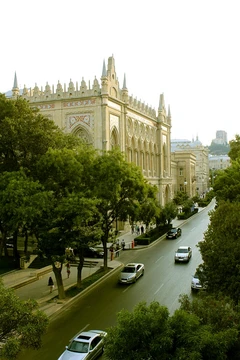
Etchmiadzin Cathedral
Often regarded as the oldest cathedral in the world.

via Wikipedia: Etchmiadzin Cathedral · see source
Etchmiadzin Cathedral is the mother church of the Armenian Apostolic Church, located in the city dually known as Etchmiadzin (Ejmiatsin) and Vagharshapat, Armenia. Constructed at the turn of the fourth century, it is usually considered the first cathedral built in ancient Armenia, and often regarded as the oldest cathedral in the world.
- location
- Etchmiadzin (Ejmiatsin) / Vagharshapat, Armenia
- founded
- 301–303 (traditional)
- denomination
- Armenian Apostolic Church
- founder
- Gregory the Illuminator
- patron
- King Tiridates III
- UNESCO listing
- 2000
- current status
- Seat of the Catholicos since 1441
Lore & Background
Etchmiadzin Cathedral was built in the early fourth century—between 301 and 303 according to tradition—by Armenia's patron saint Gregory the Illuminator, following the adoption of Christianity as a state religion by King Tiridates III. It was built over a pagan temple, symbolizing the conversion from paganism to Christianity. The core of the current building was built in 483/4 by Vahan Mamikonian after the cathedral was severely damaged in a Persian invasion. From its foundation until the second half of the fifth century, Etchmiadzin was the seat of the Catholicos, the supreme head of the Armenian Church.
Reader's Guide
Etchmiadzin Cathedral has been a central religious, political, and cultural site in Armenia. Although it suffered centuries of neglect after the fifth century, it was restored as the catholicosate in 1441 and remains the administrative headquarters of the Armenian Apostolic Church. The cathedral was plundered by Shah Abbas I of Persia in 1604, when relics and stones were taken to New Julfa. Subsequent renovations added belfries in the latter half of the seventeenth century and a sacristy in 1868. Today, the building incorporates styles from different periods of Armenian architecture. It revived during the second half of the twentieth century and under independent Armenia. A major pilgrimage site, it is one of the most visited places in the country. Along with several nearby early medieval churches, it was listed as a UNESCO World Heritage Site in 2000.
Did You Know?
- The name Etchmiadzin translates to 'the Descent of the Only-Begotten [Son of God]' but did not come into use until the 15th century; earlier sources call it 'Cathedral of Vagharshapat.'
- A granite Urartian stele dated to the 8th–6th centuries BC was excavated under the main altar in the 1950s, suggesting a pre-Christian temple on the site.
- In 450, Sasanian King Yazdegerd II built a fire temple inside the cathedral in an attempt to impose Zoroastrianism on Armenians.
- The cathedral's courtyard, measured by Lynch in the 1890s, was 349 ft 6 in × 335 ft 2 in—larger than the Trinity Great Court in Cambridge, England.
- The Feast of the Cathedral of Holy Etchmiadzin is celebrated 64 days after Easter, with a hymn written by the 8th-century Catholicos Sahak III.
Sacred Origins and the Vision of Foundation
The cathedral's origins are wrapped in one of the most striking legends in Christian tradition. According to Agathangelos's History of the Armenians, Gregory the Illuminator received a divine vision in which a figure—later identified as Jesus Christ—descended from heaven and struck the earth with a golden hammer, marking where the church should rise. This event gave the site its name, Etchmiadzin, a compound meaning 'the Descent of the Only-Begotten,' though the term did not come into use until the fifteenth century. Earlier records simply called it the Cathedral of Vagharshapat. Tradition places construction between 301 and 303, shortly after King Tiridates III made Armenia the first nation to adopt Christianity as its state religion. The church was built directly atop a pagan temple, a deliberate act of spiritual conquest. Archaeological work in the 1950s under Alexander Sahinian confirmed this layering: a granite Urartian stele from the eighth to sixth centuries BC and an amphora suggestive of a fire temple were both excavated beneath the main altar. Scholars still debate the precise timeline, with Malachia Ormanian suggesting completion in as few as seven months, while Vahagn Grigoryan proposes a span of 302 to 325.
Centuries of Resilience and Rebuilding
From its earliest days, Etchmiadzin has endured a remarkable series of destructions and restorations. The original fourth-century structure was severely damaged during a Persian invasion, prompting Vahan Mamikonian to rebuild the core of the cathedral in 483 or 484. After serving as the seat of the Catholicos—the supreme head of the Armenian Church—until the second half of the fifth century, the building then suffered what can only be described as centuries of virtual neglect. In 1441 it was formally restored as the catholicosate, a role it holds to this day. The most devastating act of desecration came in 1604, when Shah Abbas I of Persia plundered the cathedral, hauling relics and stones to New Julfa in a calculated effort to undermine Armenians' attachment to their land. In the latter half of the seventeenth century, belfries were added, and in 1868 a sacristy housing a museum and room of relics was constructed at the east end. The building was diminished during the early Soviet period but experienced a revival in the second half of the twentieth century and again under independent Armenia. Today its walls incorporate styles spanning multiple periods of Armenian architecture.
The Fortress-Like Monastery and Its Vast Courtyard
The cathedral does not stand alone but at the heart of a vast walled complex long known as the Monastery of Etchmiadzin. For much of its history this enclosure included the residence of the Catholicos and was bounded by walls roughly thirty feet high, built of brick or cob, and punctuated by eight circular towers. Nineteenth-century visitors, struck by the imposing exterior, frequently compared the whole to a fortress. The quadrangular enclosure could be entered through four gates, and at its center lay a courtyard so expansive that the English traveler Lynch, measuring it in the 1890s, recorded dimensions of 349 ft 6 in × 335 ft 2 in—larger than the Trinity Great Court at Cambridge and, he suggested, possibly the largest quadrangle in the world at that time. The town of Vagharshapat, also called Etchmiadzin, hosts several other significant early medieval churches within short distances: the seventh-century churches of St. Hripsime and St. Gayane, the ruined Zvartnots Cathedral, and the seventeenth-century Shoghakat Church. Together they form a dense cluster of sacred architecture that underscores the site's role as the spiritual nucleus of Armenian Christianity.
Living Faith, Pilgrimage, and World Recognition
Etchmiadzin remains the beating heart of Armenian Christianity, functioning simultaneously as a religious, political, and cultural center. As the Mother See of Holy Etchmiadzin, it has served as the administrative headquarters of the Armenian Apostolic Church since its restoration as the catholicosate in 1441, a position it retains in the present day. The cathedral is one of the most visited locations in all of Armenia, drawing pilgrims who come to stand in the shadow of what is widely regarded as the oldest cathedral in the world. The Armenian Church marks its importance with the Feast of the Cathedral of Holy Etchmiadzin, celebrated sixty-four days after Easter, during which a hymn composed by the eighth-century Catholicos Sahak III recounts St. Gregory's founding vision. In 2000, UNESCO inscribed the cathedral along with several nearby early medieval churches as a World Heritage Site, recognizing its outstanding universal value. Despite the plunder of 1604, the Soviet-era diminishment, and centuries of neglect, the site has continually reasserted its centrality, reviving fully in the latter half of the twentieth century and under independent Armenia.
More in Notable Buildings And Monuments 1-24
Elsewhere in the Notable Buildings And Monuments universe
Spotted an error? Know more?
This is a living reference — every entry is fact-audited, and reader corrections feed straight into our audit queue. Suggest an edit · See this site's audit record